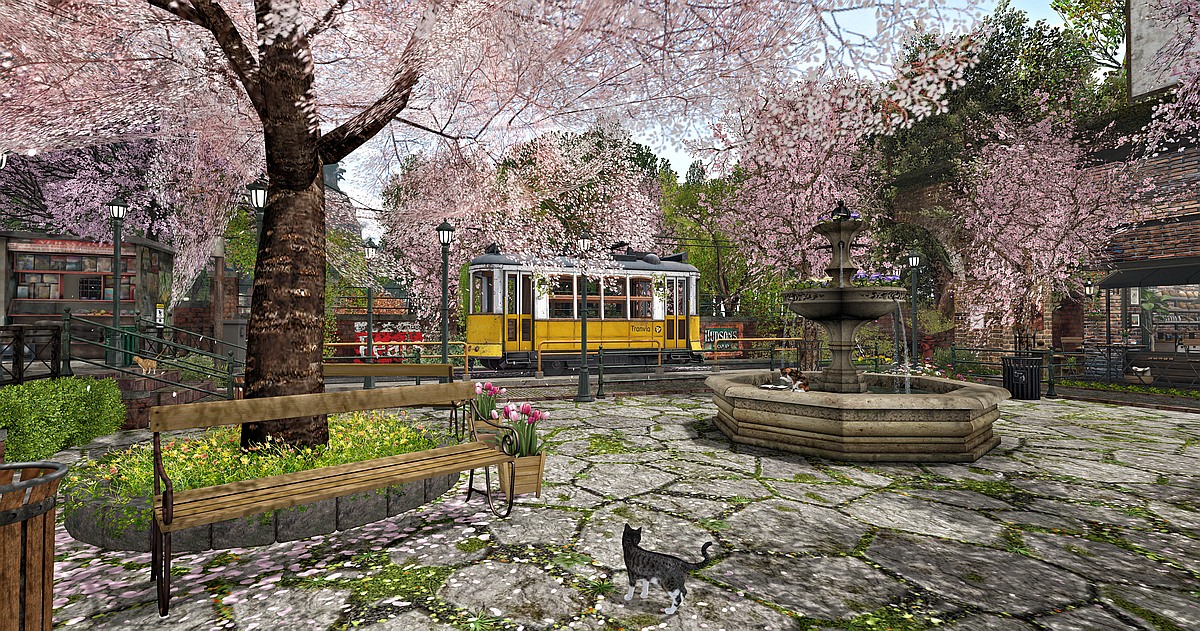
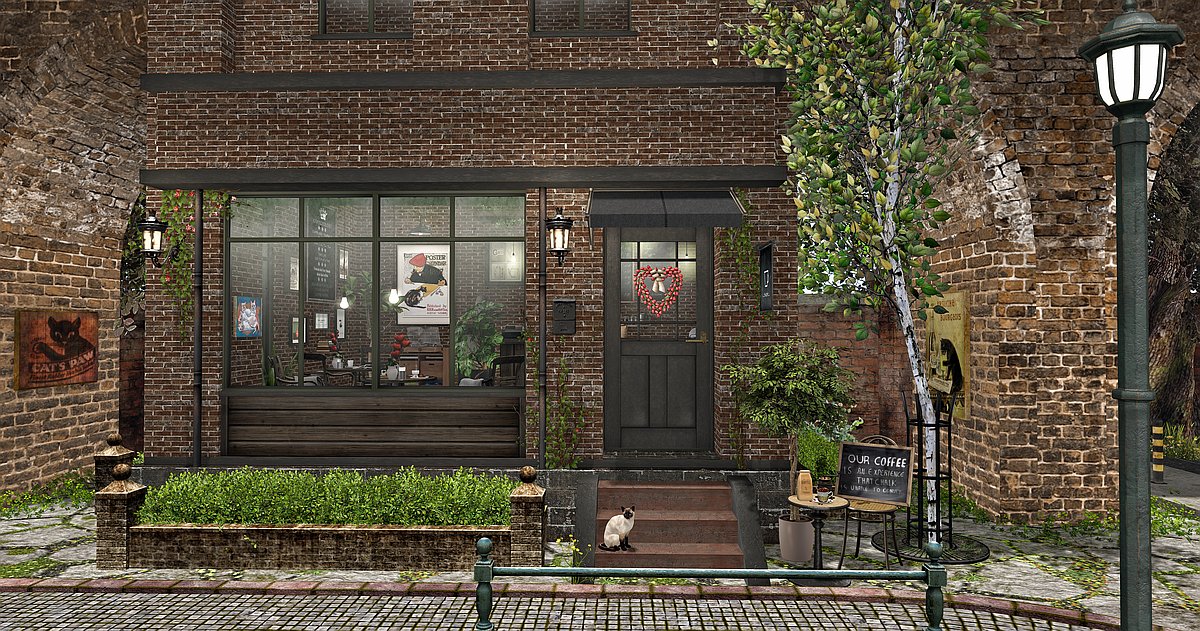
A newsstand sits adjacent Route 3, framed by sakura.
Hi-Cafe in Spring — The Blossoms Change Everything
The layout is exactly as I left it. The tram still runs along the boundary, the fountain still murmurs in the courtyard, the bookshop facade still anchors the right-hand side. But the atmosphere? Completely different.
Where there were bare branches in February, there is now a canopy of blossom. I returned to several of my earlier camera positions, and the contrast is striking. The same view, softened almost beyond recognition by layers of pink. It is a good reminder of how much a season can do to a familiar place without major relandscaping.
The outdoor seating has come back out too, which feels right. Tables and chairs along the exterior again, under the blossom — somewhere to sit and just watch petals drift.
The outdoor seating is back, and with cherry blossom arching in from both sides, it is easy to see why Hico Spicy’s post on X was enough to make me return.
Inside, Hico Spicy has made some adjustments. The wood stove that used to warm the room has gone, and the seating has been moved towards the windows. It is a simple change, but it works well — visitors now face outward, and with the trees in full bloom, that view is worth facing.
The seating now faces the window, and with the courtyard looking like this, it is hard to argue with the decision.
There is also a new bakery section. It fits naturally into the space, adding a little extra without disrupting what was already there.
The interior has been rearranged since February 2026; seating now faces the windows, and a new bakery section has been included.
A Place to Revisit
Hi-Café has not been reinvented, but it feels like a different visit entirely. The blossoms, the returned outdoor seating, the interior turned towards the view, it all comes together nicely. If you came in February, go back. If you haven’t yet, spring is the time.
In Japan, hanami; the tradition of gathering beneath cherry trees simply to appreciate their brief bloom, is a moment to pause and be present. Hico Spicy has brought something of that spirit to Route 3. The sakura won’t last, which may be reason enough not to wait.
If you’d like to see more places like this, follow my blog,Exploring Second Life, where I share both the grand builds and the smaller “quick stops” that make the grid so rewarding.
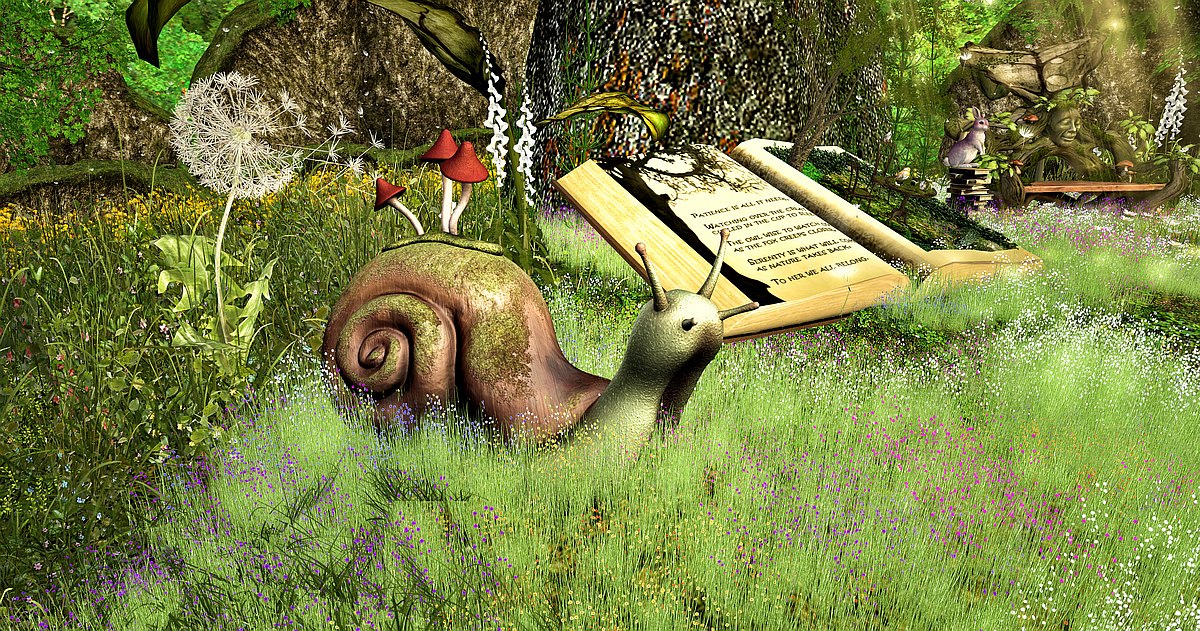
The White Rabbit receives an unusual visitor. My junkbot avatar, travelling by snail, seemed the obvious way to explore Blooming Bookshire.
A Gentle Warning
There are places in Second Life that are dangerous to visit, and LeLoo’s World Blooming Bookshire definitely falls into that category. The danger is not that you risk physical harm, rather it may adversely affect your bank balance.. The pull to teleport to shops becomes surprisingly strong here, so consider yourself warned.
Books, wildflowers, and a snail with literary ambitions — Blooming Bookshire sets its tone early.
I have visited LeLoo’s creations on and off for ten years, and one thing has never changed. Each return brings something entirely new, not a seasonal refresh but a complete reimagining from the ground up. Blooming Bookshire is her latest creation, and it is currently featured in the Second Life Destination Guide under “Photogenic Spots”.
The Twigglenook treehouse catches the eye with its string of lights. LeLoo’s World – Blooming Bookshire, Second Life
The listing, although written in rather breathless marketing language gives you a flavour of what to expect : ‘Welcome to Blooming Bookshire, where spring dances through the air and beckons you to wander its blossoming paths, whether you stroll on foot or glide along in a storybook carriage. This whimsical haven overflows with lush gardens, cosy nooks, and wildflowers that spark the imagination, inviting you to slow down, breathe deeply, and let a new tale unfold with every step.’.
A llama holds a lantern next to one of the many books placed in the landscape at LeLoo’s World – Blooming Bookshire
Meadows, Snails, and First Impressions
The theme here is books and flowers. Large books are placed around the landscape, most carrying a quotation and illustration on the cover, for example “Sometimes the smallest things take up the most room in your heart” Winnie the Pooh. The illustration shows Pooh bear with his hand in a honey jar and the book sits adjacent beehives and honey-themed details, quietly bringing the words to life.
“Sometimes the smallest things take up the most room in your heart” Winnie the Pooh. LeLoo’s World – Blooming Bookshire, Second life
The central space opens into meadowland, and it is the flowers that draw the eye first. Cattle and sheep graze peacefully among them, adding to the calm.
A peaceful meadow scene in Blooming Bookshire, Second life
Then, just as you settle into that gentle realism, the whimsy appears. Giant snails make their way across the grass, shifting the mood into something more playful.
At that point, it seemed only right to continue my exploration as a small junkbot, riding my own oversized snail. It felt entirely in keeping with the world around me.
The whimsical side of Blooming Bookshire, Second Life. Here, riding a snail seems the obvious thing to do.
A path loops around the region, offering the option of walking or taking a carriage ride. I chose the snail.
The Vignettes — Where the Detail Lives
Along the raised edges of the land, a series of small, carefully arranged scenes rewards a slower pace. These are not simply decorative touches. Each one feels complete, like a tiny self-contained world.
Bunny Burrow — one of several whimsical cottages tucked into the landscape, each with its own theme and carefully furnished interior.
The Bunny Burrow, shaped like a rabbit’s head, is thoughtfully furnished with a theme of rabbits and fungi.
Inside Bunny Burrow Cottage, with its fungi theme. Le Loo’s World – Blooming Bookshire
The Spool cottage centres on sewing, with a machine and dressmaking items filling its tiny interior.
The tiny Spool Cottage – LeLoo’s World – Blooming Bookshire
The Kitty cottage, meanwhile, is filled with wool, shelves, and gentle nods to its feline theme.
The whimsical Kitty Cottage on the outside has a distinct cat-like appearance at LeLoo’s World – Blooming Bookshire, Second Life
And yet this barely scratches the surface. Elsewhere there is a walled Secret Garden, a fast-running stream with jumping salmon, hummingbirds, ferrets, a mobile bakery, and a Madpea dispenser handing out free fluffy bunnies.
I have not even mentioned the flowers in any real detail, and the flowers alone could fill several paragraphs. To give everything here the attention it deserves would turn this post into a small book. The honest advice is simply to go and look for yourself.
Balls of wool fills the shelves inside Kitty Cottage at LeLoo’s World – Blooming Bookshire,. Second Life
A Warning About Willpower
This is both the joy and the danger of Blooming Bookshire. LeLoo clearly has excellent taste, and much of what she has chosen to display is for me, and probably for you too, highly desirable. This is where the danger lurks. It starts relatively innocently as you admire something, click it to find the designer’s name, and before you know it you are halfway across the grid.
I tried to be sensible. I failed. On leaving, I headed straight for the butterfly cabinet I had spotted in the Hobbit house library — a glass case filled with flowers and living butterflies. I have no regrets whatsoever..
Worth the Visit — and the Consequences
Blooming Bookshire rewards a slower pace. There is a great deal to notice, and it is easy to miss things if you rush.
If you enjoy places that feel thoughtful, personal, and full of quiet surprises, this is well worth your time. Just bring your willpower. Or your wallet.
Little Mobile Bookshop at LeLoo’s World – Blooming Bookshire
The Wagon Book Club surrounded by black-faced sheep, at LeLoo’s World – Blooming Bookshire, Second Life
Exploring Second Life
If you’d like to see more places like this, follow my blog,Exploring Second Life, where I share both the grand builds and the smaller “quick stops” that make the grid so rewarding.
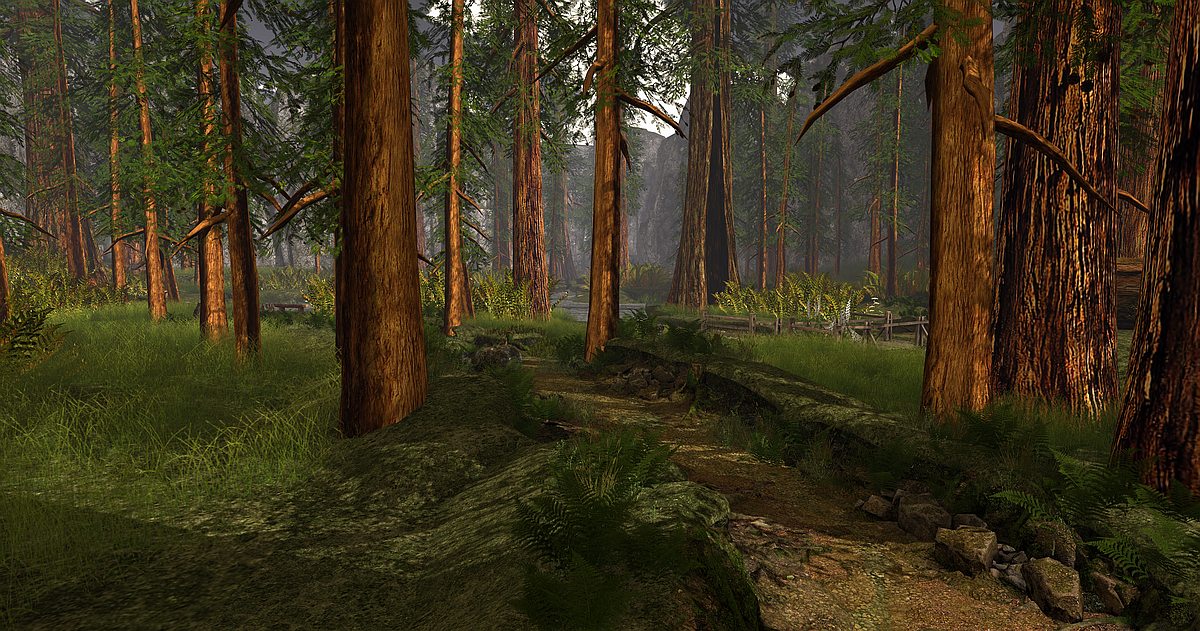
A quiet woodland path leads through towering redwoods at Cha Redwoods. Ferns and grasses soften the forest floor, while a faint glimpse of the lake draws the eye deeper into this peaceful sky high retreat.
Situated 4,078 metres above the Jeogeot mainland continent, high above the region of Cha, Cha Redwoods in Second Life is a tranquil sky platform designed by Julia Trouble. It floats quietly above the world, yet somehow feels natural, as if it has always been there.
A classic National Park Service truck is pictured among the towering trees of the Cha Redwoods, Second Life.
Julia first revealed her plans on Flickr in January 2021, and the platform officially opened on 1 February that year. Since then, Cha Redwoods in Second Life has offered woodland immersion for more than five years. In a world where many regions disappear quickly, that continuity feels remarkable
Looking up you begin to appreciate the height of the trees at Cha Redwoods, Second Life
Inspired by Redwood National Park, this destination offers a gentle escape from everyday bustle. On arrival the outside world falls quiet. In it’s place, birdsong and the sound of flowing water. This peaceful atmosphere encourages you to slow down and relax.
The lake at Cha Redwoods, Second Life
Thoughtfully placed benches and scattered seating allow a chance for quiet reflection, or to sit and chat with friends.. Winding paths welcome horseback rides or unhurried walks. It is a place for nature lovers, for photographers, and for anyone who simply wishes to sit in peaceful surroundings and recharge.
Sitting around a fire at Cha Redwoods
Paths, Water, and Woodland Detail
The platform itself has an unusual, irregular shape, formed by land availability. Narrow sections stretch eastward from both the southern and northern points.
Seen from above, Cha Redwoods reveals its unusual shape, encircled by dramatic rock walls. The lake rests near the centre, while the Lodge sits quietly among the trees, giving a sense of how thoughtfully the woodland retreat is arranged.
You arrive at the narrow south eastern corner, between high granite cliffs. From there, a path slopes gently down past a wooden fence and into the trees.
Riding along a path at Cha Redwoods
Soon the path divides. Continue east and you follow the southern bank of the stream towards the lake. Turn north and you cross a bridge towards the Park Lodge and a nearby wooden cabin. In truth, the order hardly matters. The platform invites complete exploration.
the path splits in two directions, the left towards the lake, while the right heads to the lodge and waterfall, Cha Redwoods
The woodland colours feel natural with greens and browns dominating, broken here and there by white foxgloves and Queen Anne’s lace, and the soft yellow of buttercups.
Wueen Anne’s Lace and Buttercups add a splash of colour at Cha Redwoods
These touches are used sparingly, which makes them more striking. Dragonflies skim the lake’s surface, bright darting flashes of colour that bring the scene to life.
Paths run between the trees at Cha Redwoods, Second Life
At times, the immersion feels so complete that I almost imagine the rich scent of redwood forest earth.
Sound, Story, and Small Surprises
Ambient sound forms part of the experience. However, those who prefer music can enjoy a stream provided by Megaton Cafe Radio, offering music from the 1920s to the 1950s. Several trees also contain a hybrid dance machine, allowing both solo and couple dances, which adds a playful touch.
White foxgloves at Cha Redwoods, Second Life
The Park Lodge introduces a subtle mid century narrative. Postcards displayed as if for sale have a 1950s feel. A framed notice declares “Best Small Motel of the Year 1954.” An old brown radio, when clicked, plays Glenn Miller,
The reception area at the Park Office, Cha Redwoods
On my most recent visit I noticed something new. The telephone at reception rings occasionally. When answered, a voice delivers one of several brief messages. It is a small detail, but adds interest.
The interior of the wooden cabin at Cha Redwoods, Second Life
At the north eastern corner, where the stream enters the region, a waterfall conceals another surprise. Walk carefully through the rock and you discover a hidden passage beneath the Redwoods, leading to a small bar tucked quietly underground. It feels like a reward for exploring thoroughly
Other bloggers have also explored this peaceful sky retreat, including Inara Pey and Maddy Gynoid. Their posts are well worth reading alongside this one.
I cannot improve upon Julia’s original invitation:
“Welcome back to nature. Come for a long walk in the woods or just sit and think by the lake watching the dragonflies play… just relax and let the stress of the world slip away.”
Whether you come for solitude, photography, or simply to sit beside the lake and watch the dragonflies, there is plenty here to reward you. Cha Redwoods is, by any measure, one of Second Life’s more enduring natural environments.
If you’d like to see more places like this, follow my blog,Exploring Second Life, where I share both the grand builds and the smaller “quick stops” that make the grid so rewarding.
Last July I visited Raven’s Bay, Lilly Blackwood’s evocative homestead described as “an island of mystery and magic.” I remember being quietly impressed by the atmosphere she created there. So when I discovered she had opened a new region, Bitter’s End, I went to explore without hesitation.
Small clumps of white flowers punctuate the woodland green at Bitter’s End, Second Life
Lilly invites visitors to “Journey to this remote island in the Pacific Northwest and explore the many trails through the forest and along the rugged coast.” From the moment you arrive, that promise feels real.
A stream runs east to west across Bitter’s End, in Second Life
The landing point, at the northern tip of the island, places you in a courtyard open to the sky. Cracked paving slabs lie underfoot. The surrounding walls stand in varying states of decay. In one corner rises a statue, perhaps a woodland goddess, with antlers and elven ears. Vines climb the stonework, and a tall tree grows in the opposite corner.
A statue of a woodland goddess stands in a corner of the courtyard at Bitter’s End , Second Life
What was this place once? A chapel, a hall, a forgotten stronghold? The mystery draws you in immediately.
Sea, Stone and Stillness
There are exits on all four sides of the courtyard. Passing through the northern gateway, where wooden gates still hang from their hinges, you step onto a paved approach that leads to a large statue of Buddha seated on rocks with his back to the sea.
It is a peaceful sight. Waves roll in below. The lighting, when using the shared environment, glows with a gentle rosy sunset. With sounds enabled, the sea completes the illusion. This is a place to pause and sit quietly in thought.
The Buddha gives the opportunity for one or two avatars to meditate
A pathway curves left along the coast. Here the paving changes to irregular stones, less formal, more natural. Before long you reach a wooden deck that stretches out over the water. Two chairs wait there, facing the horizon. From this vantage point you can see a lighthouse in the distance, and deer stand on the nearby rocks.
A deer, one of a small family group, at Bitter’s End in Second Life
Forest Paths and Hidden Corners
Return to the courtyard and choose another exit, and the sense of adventure deepens. Each path winds into woodland. You cannot immediately see where any of them lead, which makes exploration feel genuine.
A statue of a goddess at Bitter’s End, Second Life
Follow the coastal trail a little further and you come upon a small café tucked into the landscape.
Gulls circle above the Cafe at Bitter’s End, Second Life
It is modest in size, with just three tables, yet that intimacy gives it charm. Step inside and it becomes a cosy place to sit with a friend and talk.
Inside the cafe, at Bitter’s End in Second Life
Bitter’s End is not a place that shouts for attention. It invites you to slow down, explore, and notice the details. Whether you come alone or with a companion, the forest, coast, and quiet corners offer space to breathe. I hope you enjoy discovering it as much as I did.
If you’d like to see more places like this, follow my blog,Exploring Second Life, where I share both the grand builds and the smaller “quick stops” that make the grid so rewarding.
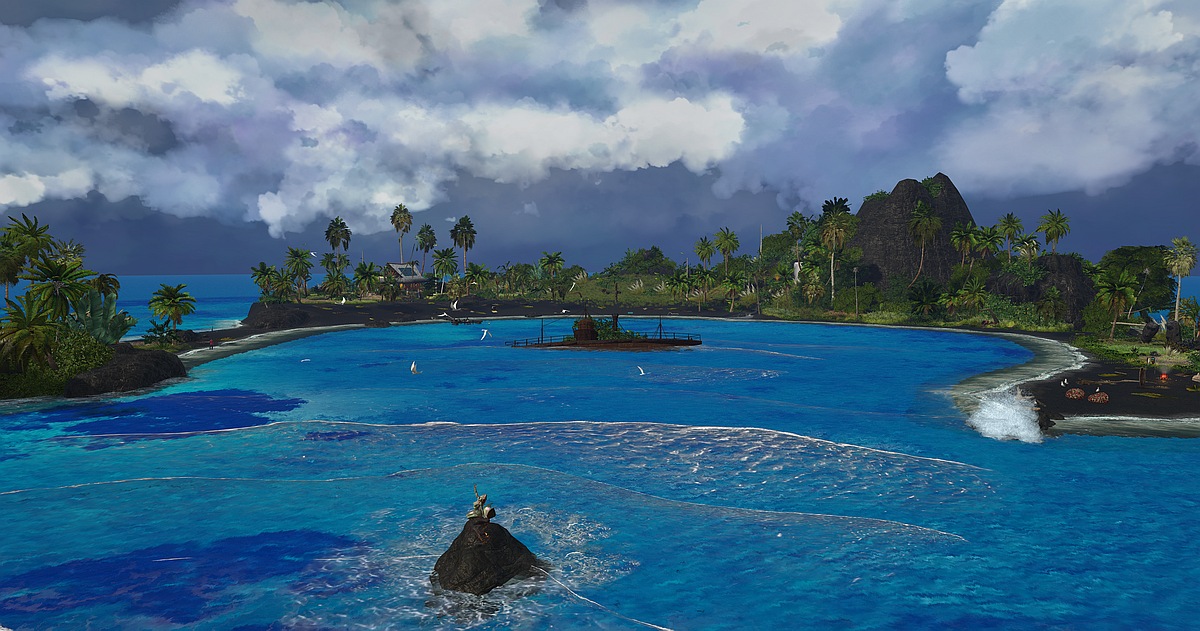
The horseshoe shaped bay at Sable Noir, where black volcanic sand meets the sea and a half sunken submarine adds a note of mystery
Some regions in Second Life make an immediate impression through colour and light. Others draw you in through atmosphere and sound. Sable Noir belongs firmly to the latter, a place that feels alive from the moment you arrive, restless, dramatic, and quietly seductive.
Two tortoises at Sable Noir, a small detail from the island’s abundant wildlife.
A Volcanic First Impression
Resembling a horseshoe, Sable Noir Island rises from the sea as a tropical haven of black volcanic sand.. The landscape tells its story clearly. Fire shaped this land. At the heart of the island sits the remains of a dormant volcano, its summit now holding a pool of water teeming with life, while offshore to the north an active volcano smoulders, sending a constant reminder of unrest into the sky.
A brightly coloured frog rests on a lily pad, one of many small discoveries at Sable Noir.
Storm, Sound, and Atmosphere
The weather plays a major role here. Storm clouds roll overhead, thunder rumbles almost continuously, and rain sweeps across the island in sudden bursts. It is thoughtful touches like these that show the care behind the design. Near the arrival point, the region owner and designer Aɴᴀsᴛᴀsɪᴀ Jᴜʀɪʏᴀ has even provided a free umbrella, a small but welcome detail that immediately sets the tone.
A stream flows down from the dormant volcano at Sable Noir, cutting through dense tropical vegetation.
To appreciate Sable Noir fully, it is important to use the shared environment settings and to have sound enabled. Waves crash against the shore, thunder echoes across the landscape, and tropical birds call from the trees. At times, there is something more haunting, the distant song of a siren drifting through the air, adding a touch of mystery and unease.
A quiet moment at Sable Noir, with tea, birds close by, and a lemur wandering through the scene.
Hidden Details and Living Wildlife
The land description hints at hidden, playful spots scattered across the island. In fact, they are indeed there, discreetly tucked away and using modern animations. However, even setting those aside, Sable Noir stands on its own as a beautifully crafted tropical environment. Furthermore, the flora is lush and varied, and the wildlife is particularly impressive. For instance, many bird species inhabit the island, including several I haven’t seen elsewhere in Second Life. In addition, you will also find reptiles, amphibians, and even a lemur.”There is nothing here which feels inappropriate for a remote volcanic island.
A blue hummingbird in close up, one of the many bird species found across Sable Noir.
A Place to Explore and Return To
What is especially surprising is how much is concealed within a landscape that is relatively low lying, aside from the volcano itself. Paths twist away, details reveal themselves gradually, and exploration is consistently rewarded. Listing everything would spoil the pleasure. This is a place best discovered at your own pace.
Statues and wildlife at Sable Noir
Why Visit Sable Noir
Sable Noir will naturally appeal to couples, yet it is similarly rewarding for explorers and photographers. Furthermore, it offers inspiration for sim designers and even dedicated Second Life bird watchers It is atmospheric, immersive, and thoughtfully designed. Very highly recommended.
Inside the house at Sable Noir, full of detail and interest.
If you’d like to see more places like this, follow my blog,Exploring Second Life, where I share both the grand builds and the smaller “quick stops” that make the grid so rewarding.
Planet M’s Tula in Second Life is one of those places that stands out from the crowd. From the moment you arrive, there is a clear sense that you are somewhere very different from the norm. If you enjoy quirky landscapes, Second Life animals, or simply visiting places created in an imaginative and playful style, Planet M’s Tula may well appeal.
A contented frog on a giant lily pad – Planet M
Sound, Light, and Atmosphere
Before exploring, I would strongly recommend enabling the shared environment and turning on the region sound. I do not usually play music streams when visiting a place, but here it feels essential. What you hear is not music, but a carefully layered soundscape, bird calls drifting through the air, the croak of frogs near water, and subtle ambient noises that gently draw you into the valley. Combined with the lighting, it creates an immersive atmosphere that feels completely matched to the landscape
Elephants by a pool – high in the sky at planet M’s Tula
Arrival and Exploration
The landing point places you on a small island in the middle of a flock of flamingos. Ahead of you is a free explorer bubble, which you can add, large enough to sit comfortably inside. Transparent, with a soft reddish tint, it allows you to float and fly around the region using the arrow keys and page up and down controls on your keyboard. It is both playful and practical, and makes drifting between levels feel entirely natural.
Sizing each other up – photographer – Nan Slade
A World Imagined into Being
The official Second Life Destination Guide describes Planet M’s Tula as “a surreal red-earth valley shaped by organic forms, roaming animals, and a ceramic studio at its heart”. While the landscape is certainly strange, alien even, Myrdin Sommer, the designer of Planet M’s Tula, has achieved the remarkable feat of making it feel like a complete world imagined into being, with its own internal logic
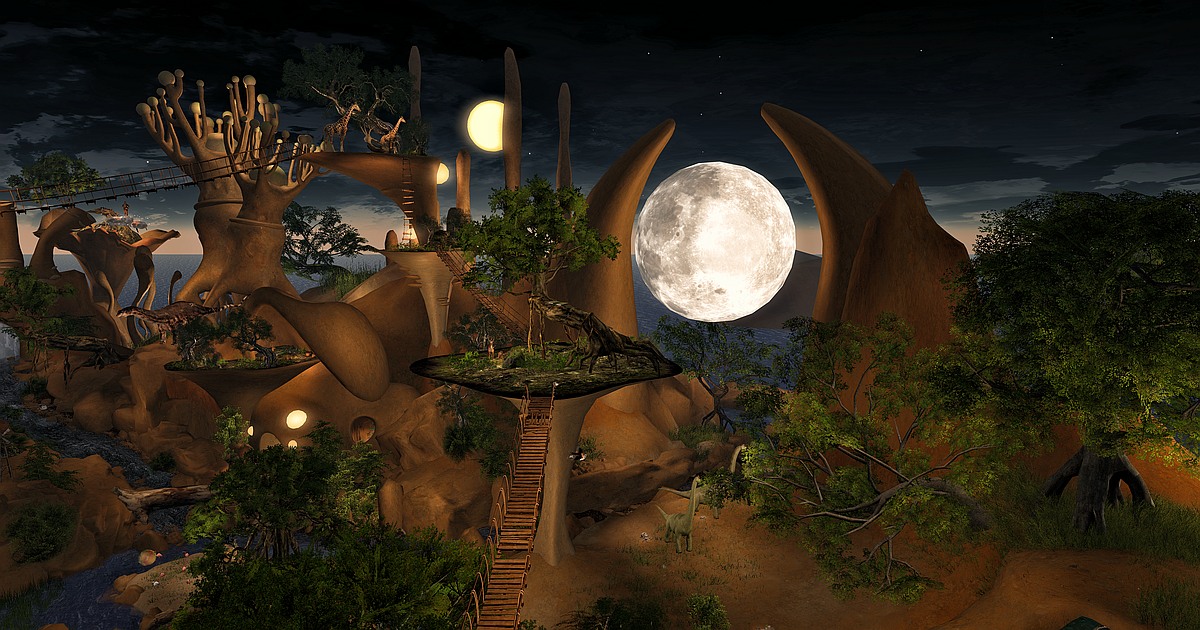
The valley unfolds in warm red and reddish-brown earth tones, sculpted into organic forms that curve and rise as if grown rather than built. Tall, finger-like structures reach upward, while other forms broaden at the top, creating flat-topped shapes like giant fungi or isolated plateaus. On these elevated platforms you can see a wide range of animals. Some plateaus contain shallow basins, which may hold ponds or, in some cases, trees. Nothing here appears accidental, yet very little follows the rules of a natural landscape as we understand it on our own planet.
Planet M’s Tula – Photographer Nan Slade
Life on the Plateaus
Life is everywhere, though never quite where you expect it. Trees cling to elevated platforms, animals wander calmly across spaces that could never sustain them, and a river threads its way through the valley below, bringing movement and sound to the stillness of the stone. Seeing large animals standing on unreachable ledges is surprising at first, but quickly becomes a quiet pleasure, with each new plateau inviting curiosity about what creature might appear next.
Giraffe on Planet M
Clay, Craft, and Daily Life
The buildings are well worth closer investigation. Made from the same clay-like substrate as the rest of the planet, they form curious rooms with rounded corners and interiors that feel lived in rather than staged. There is a kiln, its open door revealing pots inside while a fire burns beneath, fed by stacked wood. Through the next doorway you arrive at the pottery workshop, with clay pots and other objects stacked on shelves. It was here that I found Myrdin Sommer seated at the table, apparently working on a pot, her avatar accompanied by animals in a way that felt both whimsical and entirely at home. On a windowsill nearby, a dodo sits quietly, incubating an egg.
Myrdin Sommer at work – assisted by two friends
Above, reached by a ladder, is an art studio, where abstract paintings are stacked around the room, some finished, others still in progress. Outside, a wind turbine turns quietly, suggesting not decoration but function. Wind exists here, power is needed, and craft matters.
Art studio – Planet M’s Tula – Second life
Accepting Tula’s Logic
These details shift the experience of Tula. This is not simply a strange landscape to pass through, but a world that works on its own terms, operating according to its own logic. Planet M’s Tula in Second Life invites you to suspend disbelief and accept its rules. It is quirky, imaginative, and rich with photographic possibilities, a place that rewards curiosity and quiet exploration.
Moonlight over the red-earth plateaus of Planet M’s Tula in Second Life.
If you’d like to see more places like this, follow my blog,Exploring Second Life, where I share both the grand builds and the smaller “quick stops” that make the grid so rewarding.
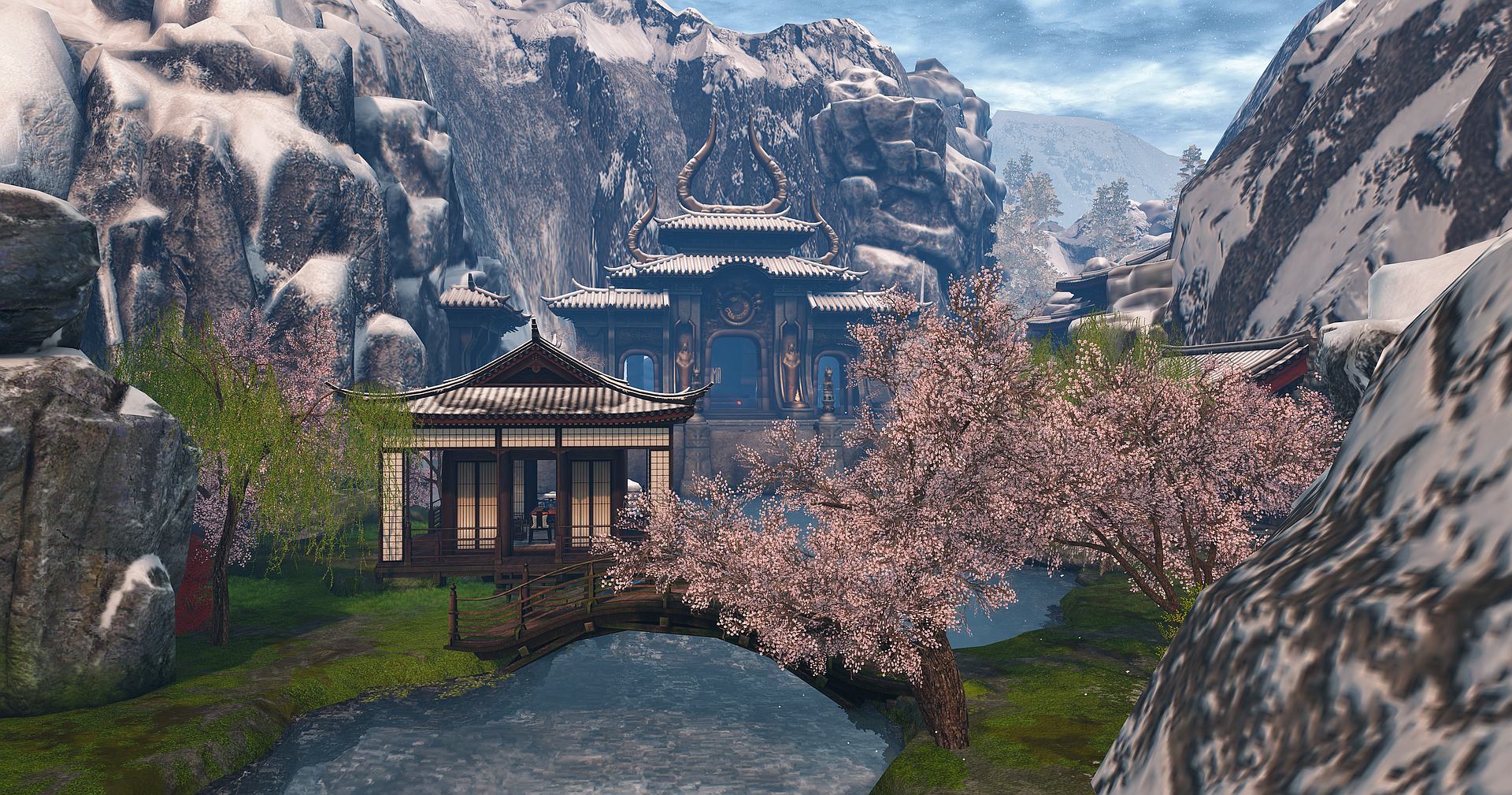
Surrounded on three sides by sheer cliffs of snow and ice, the JOMO & YUSR Main Store juts out from the mountainside like a temple of old, its styling unmistakably Asian. Only the front façade is visible — a grand entrance flanked by imposing statues — while most of the store lies hidden deep within the mountain. Even if you’re not looking to buy, it’s worth exploring. Inside, the cool stone walls and dark paved floors create the sense of being in a special place; if it were real life, you might find yourself speaking in a whisper. Light falls in pools that reveal not only the creations for sale but other quiet details, all adding to the mystery and atmosphere.
The temple-like entrance to JOMO & YUSR, carved into the mountainside
A miniature Shangri-La
The landscape feels both beautiful and inhospitable — a place where the elements dominate. The region forms a vast mountainous horseshoe that rises to about 84 metres, with snow-covered peaks in every direction. Yet in front of the store lies a surprising patch of green: flowering cherry trees, the soft hum of dragonflies crossing the water, and a pool warm enough to bathe in. It feels like a miniature Shangri-La within an otherwise frozen world. Perhaps the warmth comes from unseen geothermal springs, though that’s left to the imagination.
Jomo viewed from overheadCherry blossoms and dragonflies and a chance to bathe in the open air
Exploring further afield
Beyond the main building, there’s much to explore. To the left of the store is a blacksmith’s forge, complete with animated tools — perfect for photos as you sharpen blades or hammer them into shape. Many of the forge’s contents, from weapon racks to individual weapons, are free or just one linden — a gift to anyone building a role-play region. On the right stands a pavilion, where a polished rosewood table is laid out for a tea ceremony. Nearby, hidden within the rocks, a cavern shelters a magnificent sleeping Buddha.
Heating the metalBeating a sword into shapeSharpening a blade
On the right stands a pavilion, where a polished rosewood table is laid out for a tea ceremony
A tea set laid out on a rosewood table
Nearby, hidden within the rocks, a cavern shelters a magnificent sleeping Buddha.
The sleeping Buddha carved into the rock
On the far side of the mountain, another cluster of buildings clings to the cliffs, each carefully furnished.
A cluster of buildings clings to the cliffs
The highlight here is a detailed giant golden statue of Avalokiteśvara, with fruit offerings that lend a sense of quiet devotion.
A quiet moment near the Avalokiteśvara statue
The adventure doesn’t end there — a winding path of steps leads the energetic to the very peak, where the views are breathtaking
A view of the steps on the mountain at Jomo—Second Life
Reflections
JOMO has changed many times over the years. Earlier versions — described by Inara Pey (2013), Maddy Gynoid (2015), A Sunny Difference (2016), and Susann Decuir (2020) — all shared the same sense of wonder. Each build carried echoes of Asian landscapes and mythic calm. The current version continues that tradition, the work of creators xiaoduo Abbot and 大鱼 (deo.rain),
A Place to Linger
If you visit JOMO, take your time. Don’t rush straight to the store. Let the snow settle, listen for the wind, and walk slowly down to the water. You’ll find that this place — part shop, part temple, part dream — reveals itself best in stillness.
If you’d like to see more places like this, follow my blog,Exploring Second Life, where I share both the grand builds and the smaller “quick stops” that make the grid so rewarding.
Autumn has arrived at La Vie en Rose in Second Life, bringing a fresh wave of colour to the familiar landscape. While the layout of the sky garden remains much the same, the grasses now shimmer gold and the trees blaze with rich reds and oranges. It’s a seasonal renewal by Beautiful Requiem and Rose Ulrik that transforms the atmosphere, offering a perfect excuse to return and wander once more.
I’ve written about La Vie en Rose before, when its peaceful tropical setting first opened to visitors. The ground level, with its large lake, beach, rental houses and abundant bird life, remains unchanged. However, up above , the seasons have changed on the sky platform known as ‘the garden’, where a fresh burst of autumn has arrived.
The trees and grasses add vinrant colours to the garden
A Seasonal Renewal
The renewal was once again created by Beautiful Requiem (BeautifulDisaster Requiem) and Rose Ulrik (Rose Siabonne), and while the basic configeration of the platform is much as before, with the ponds, rocks, and houses still in place, the mood has changed entirely with the turn of the seasons.
Poppies add contrasting colour, here and there in the field
Autumn Colours Across the Platform
To the east, grasses now sweep across the land in shades of yellow, punctuated with little dots of red poppies. The western side, where the houses sit, is ablaze with trees in vivid autumn colours. A few new details, birds here and there, subtle changes in planting, but the real transformation lies in the trees and grasses.
It is a striking renewal: familiar, yet freshly alive in autumn tones, amd a visit is highly recommended.
Some of the birds have been added during the autumnal relandscaping.
If you’d like to see more places like this, follow my blog,Exploring Second Life, where I share both the grand builds and the smaller “quick stops” that make the grid so rewarding.