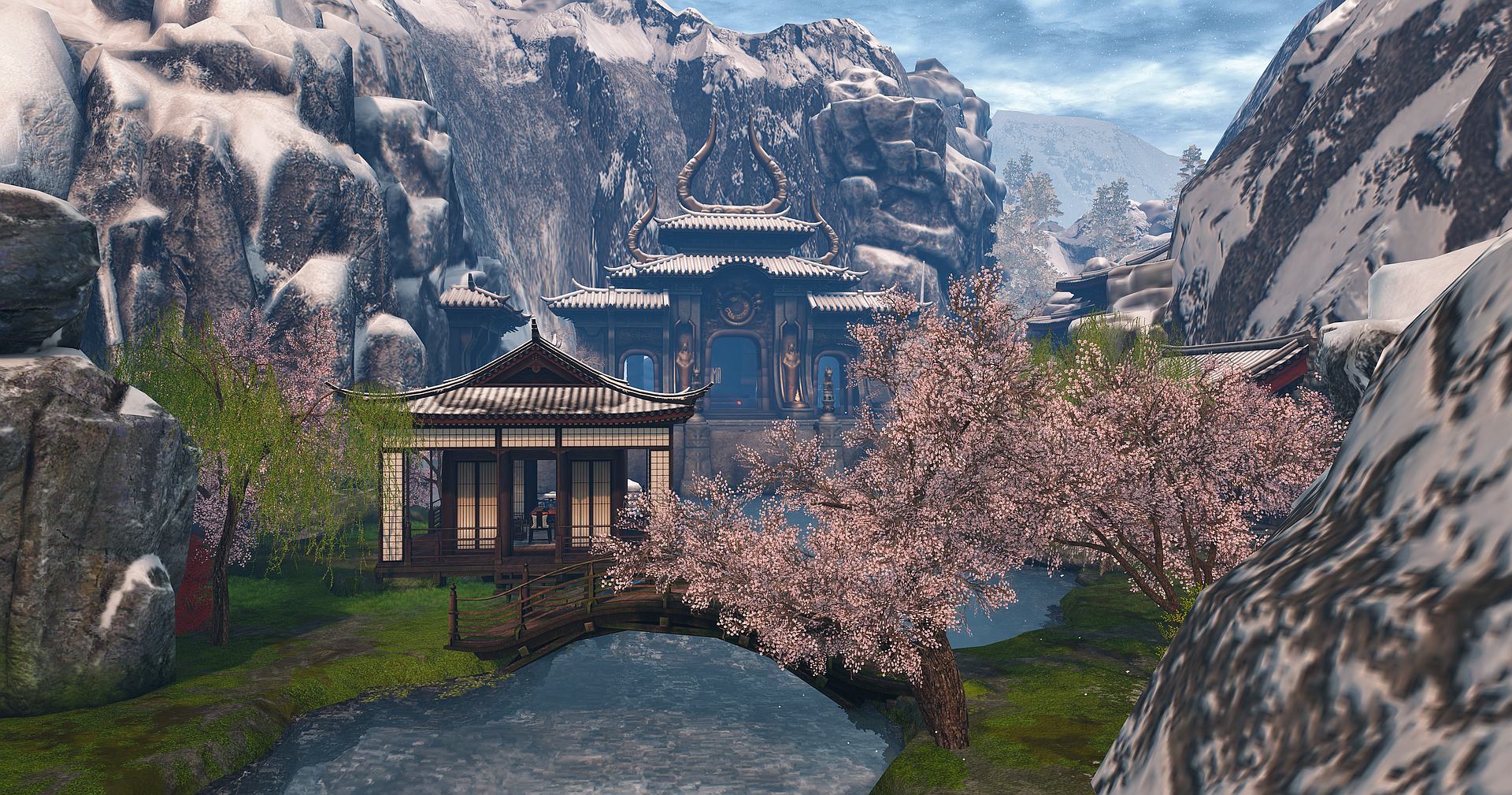
High above Second Life, at an altitude of 1,800 metres, Peng Lai floats quietly among the clouds. The name is inspired by Chinese mythology, where Penglai (蓬萊) is said to be a mystical island in the Eastern Sea where immortals live. Created by 水 (polees) Peng Lai offers a serene and carefully composed retreat shaped by ancient art, symbolism, and Taoist philosophy. It is a place that feels removed from the everyday, suspended somewhere between landscape, legend, and contemplation.

Peng Lai isn’t massive, nor does it try to overwhelm you. Instead, it invites slow exploration.. With a modest prim count of 703 across an area of 2048 square metres, it feels carefully curated, dreamlike, and intentionally restrained. This is a place that is both aesthetically beautiful and thoughtfully designed, balancing exploration, and participation.

水 (polees) explains is motivation simply. “I came to SL a few years ago and found only a few truly exquisite Chinese buildings and artworks. I wanted to showcase them and share this beauty with everyone. My purpose is to bring art into SL, to make it accessible.”

Arrival and First Impressions
Visitors arrive at Peng Lai through an impressive gateway set on worn stone flagstones, with stone lamps flank the entrance Decorated with carved details and Chinese characters, the structure immediately sets the tone.

From here, dark stained wooden steps rise upward, bordered by sturdy wooden balustrades, leading towards the heart of the region. Peng Lai floats on five large rocks, where drifting cloud effects hide the bases. A vast enclosing sphere houses the entire build, displaying misty grey and white mountain forms in the style of traditional Chinese ink art The effect is subtle and immersive, creating the feeling of walking within a living scroll painting rather than a conventional landscape.
The Central Stone Platform
At the centre of Peng Lai lies a large circular stone platform that acts as both visual anchor and symbolic crossroads Intricate flowing motifs cover the surface, while a Yin Yang symbol dominates the centre The creator has placed Tai Chi pose balls here, reinforcing its role as a space dedicated to balance, movement, and calm discipline.

Dark wooden stairways extend from the platform in several directions, their railings punctuated by polished finials.The contrast between carved stone and finished wood feels intentional and harmonious, reflecting long established East Asian architectural principles.
The Shrine of Lü Dongbin
To the left of the central platform stands a wooden building, reached by a short paved path and a further flight of steps. Its dark tiled roof curves gently upward at the eaves, and lanterns mark the entrance. Inside, the atmosphere becomes immediately quieter and more introspective.

A framed painting of Lü Dongbin, one of the Eight Immortals of Taoism,hangs on the central wall. On either side are two classical texts, both attributed to him, works associated with Taoist thought on inner cultivation and harmony with the Dao. Rather than explaining these writings in detail, Peng Lai allows them to stand as cultural touchstones, inviting those who wish to explore further to do so at their own pace.
Lanterns softly light the room, while low tables and seating fill the space, creating an atmosphere suited to contemplation, study, or quiet rest

Ascending to the Main Sanctuary
Continuing upward from the stone platform, a longer flight of steps leads to the highest point of Peng Lai. This grand building forms the spiritual centre of the region. Its scale, complex roof structure, and rich dark woodwork immediately suggest a place of importance

Inside, three altars face the room. These figures are commonly understood to represent Taishang Laojun, closely associated with Laozi and the foundations of Taoism. Alongside him are Bian Que, revered for healing, and Guan Yu, symbolising loyalty, righteousness, and moral strength. Low seating with purple cushions is arranged neatly before the altars, suggesting meditation, teaching, or quiet ceremony.

Heavy wooden beams, golden screens, and draped curtains lend warmth and gravity without making the space feel heavy. The atmosphere remains calm, open, and quietly welcoming.
Outside the building stand two red crowned cranes. In Taoist symbolism, these birds are associated with immortals and transcendence. Their placement here feels deliberate rather than decorative.

Contemplative Spaces and the Tea Deck
Near the cranes are a carved stone table and seating. Another feature here is a large square platform inset with a circular Luopan, the traditional Chinese geomantic compass. Its presence suggests that Peng Lai was planned with alignment and harmony in mind, not only visually but philosophically.

To the right of the central platform, a dogleg path leads to a raised wooden tea deck. Here, single long low table sits at the centre, accompanied by tastefully decorated floor cushions.
Flora at Peng Lai is carefully and sparingly placed, echoing the sensibility of Zen gardens. Bamboo, flowering cherry trees, , acers, and pines, add to a sense of beauty and calm.

At the outer corner of the path sits a large bowl filled with water and lotus flowers, while from the rock supporting the main sanctuary a waterfall spills gently downward, disappearing into the mist below. The overall effect is unhurried and beautifully composed, encouraging visitors to sit, look outward, and simply be.
A Quiet Place Worth Returning To
Peng Lai does not attempt to explain everything it contains. Instead, it offers atmosphere, craftsmanship, and cultural cues, trusting visitors to engage at whatever depth feels right for them. Those familiar with regions such as JOMO will recognise a shared appreciation for historical reference, careful design, and calm immersion.
For the intended experience, be sure to use the shared environment settings.
Whether you come to practice Tai Chi, enjoy tea, reflect quietly, or simply exploration, Peng Lai remains a peaceful retreat that rewards both curiosity and stillness. It is a place to slow down, to look carefully, and to linger a while.
Useful Links
Teleport to Peng Lai
Teleport to Jomo JOMO – Serenity in the Snow
If you’d like to see more places like this, follow my blog, Exploring Second Life, where I share both the grand builds and the smaller “quick stops” that make the grid so rewarding.
Join us in the Second Life Destinations Facebook Group, where bloggers share new finds.
Photographers: post your snapshots in the Second Life Destinations Flickr Group.